
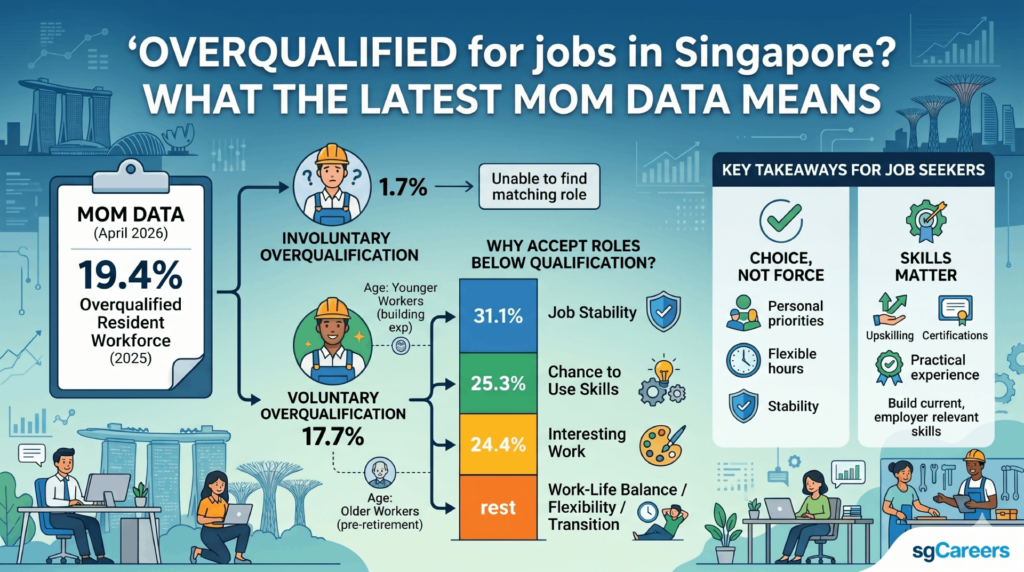
Being called “overqualified” can sound like bad news during a job search. But in Singapore’s current labour market, it does not always mean a worker is stuck in the wrong role. In many cases, it reflects a deliberate career decision shaped by flexibility, stability, life stage, or a desire to switch industries. According to a Ministry of Manpower study released on 14 April 2026, 19.4% of Singapore’s resident workforce was overqualified for their jobs in 2025. That is still lower than the 21.6% average across high-income economies.
What does overqualified mean in Singapore?
MOM defines overqualification as a situation where a worker’s highest academic qualification is above the level typically required for their occupation. The study used an internationally comparable measure developed with the International Labour Organization, and the findings were based on data from about 33,000 households in Singapore’s Comprehensive Labour Force Survey.
Most overqualified workers in Singapore are there by choice
The most important takeaway from the latest data is that overqualification in Singapore is usually voluntary, not forced. MOM and NTUC said that only 1.7% of the resident workforce was involuntarily overqualified in 2025, meaning they could not find jobs matching their qualifications. By contrast, about nine in 10 overqualified workers, or 17.7% of the workforce, were in these roles because of personal preferences such as work-life balance, flexibility, or career transition.
That matters for job seekers. A job that looks “below your qualifications” on paper may still make sense if it offers something valuable: better hours, lower stress, a more stable employer, a chance to gain experience, or a pathway into a new industry. In Singapore’s job market, career progress is not always linear, and many workers are clearly making more intentional choices about what kind of work fits their lives best.
Why workers in Singapore accept jobs below their qualification level
Among workers who voluntarily took roles below their formal qualification level, the most common reasons were job stability (31.1%), the chance to use their skills (25.3%), and interesting work (24.4%). Others preferred jobs that offered suitable hours or more flexible work arrangements. MOM said some of these workers might have been matched to roles more aligned with their qualifications if more flexible arrangements were available.
For employers, this is a useful signal. Candidates are not always chasing the biggest title or the highest paper match. Many are evaluating roles based on quality of life, purpose, and career sustainability. Companies that offer flexibility and clearer career mobility may be better positioned to attract skilled talent.
Younger workers and older workers face different career realities
The MOM report found that overqualification was more common among younger workers, especially those early in their careers. Among involuntarily overqualified workers, more than one-third are under 35, likely because they are still building experience before moving into roles that better match their qualifications. At the other end of the workforce, workers aged 60 and above were more likely to be voluntarily overqualified, suggesting that some choose less demanding roles or different career options as they move towards retirement.
This is important context for job seekers in Singapore. A first job, mid-career reset, or pre-retirement role may not reflect a person’s full educational background, but it can still be the right move at that stage of life.
Singapore jobs are increasingly about skills, not just qualifications
The broader implication is that qualifications alone are no longer the best measure of job fit. Singapore has a highly educated workforce, with 64% holding tertiary qualifications, compared with an average of 41.2% in other high-income economies. Even so, the report suggests that labour market outcomes depend not just on education, but on whether workers continue to refresh their skills and gain relevant experience. MOM and NTUC said the findings should be viewed in the context of a fast-changing economy where the value of skills can change quickly over time.
For job seekers, that means the smartest strategy is not simply aiming for roles that perfectly match your degree. It is building practical, current, employer-relevant skills and showing how you can contribute from day one.
What this means for job seekers on sgCareers
If you are worried about being overqualified for a role, the latest Singapore data offers some reassurance. Being overqualified is not always a sign of underemployment or failure. It may reflect a strategic choice to prioritise flexibility, stability, interest, or long-term career goals.
When applying for jobs in Singapore, focus on explaining your motivation clearly. If you are making a career switch, say so. If you want more flexible hours, position that honestly and professionally. If you are taking a role to gain industry experience, frame it as a deliberate next step rather than a compromise. Employers are often more open to these moves than candidates expect.
A better way to think about overqualification in Singapore
The latest MOM figures show that while nearly 1 in 5 workers in Singapore is technically overqualified for their job, the vast majority are there by choice, not because the labour market is broken.
For job seekers, the lesson is simple: the best job is not always the one that matches your qualification level exactly. It is the one that matches your skills, your priorities, and the direction you want your career to take next.