
Looking for a job in Singapore in 2026? The labour market is still creating opportunities, but employers are hiring more selectively. Candidates who target suitable roles, tailor every application and show evidence of practical skills are more likely to stand out than those who send the same resume everywhere.
Quick answer: How do you improve your chances of getting hired in Singapore?
Choose two or three realistic target roles, tailor your resume to each job description, show measurable achievements, prepare examples using the STAR interview method, and use recognised career or training support where relevant. Do not measure progress only by the number of applications sent. Track shortlist rates, interview feedback and the skills repeatedly requested by employers.
Singapore Job Market Outlook for 2026
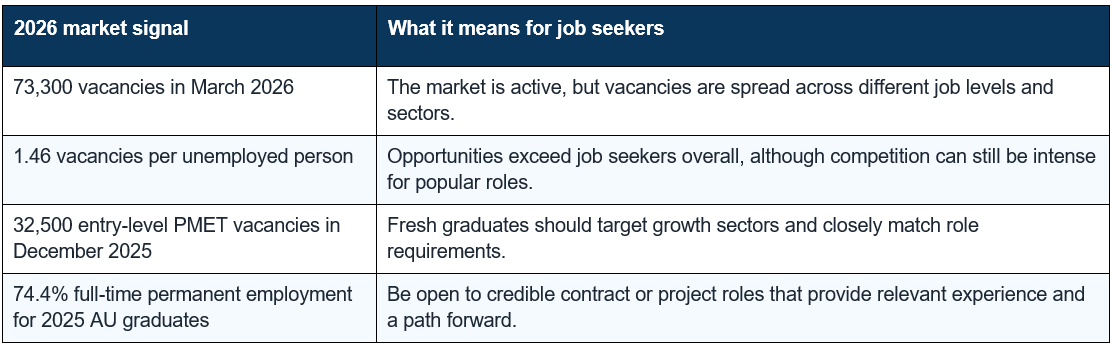
Singapore’s labour market remains resilient, although global uncertainty is making some employers more cautious. The Ministry of Manpower reported 73,300 job vacancies in March 2026, equivalent to 1.46 vacancies for every unemployed person. This means hiring demand continues to exceed the number of job seekers, even as companies become more deliberate about headcount and wage growth.
For entry-level professionals, the market is competitive but not closed. There were 32,500 entry-level PMET vacancies in December 2025. These opportunities were concentrated in Financial & Insurance Services, Information & Communications, Professional Services, and Health & Social Services.
Fresh graduates should also set realistic expectations. Among autonomous university graduates in the labour force, 88.9% secured employment within six months of their final examinations in 2025, while 74.4% obtained full-time permanent employment. Contract, project-based, freelance and voluntary temporary roles therefore form a larger part of the early-career market than they did during the post-pandemic hiring surge.
Which Jobs Are in Demand in Singapore?
MOM’s 2025 job-vacancy report highlighted continued demand for software, web, multimedia and game developers and designers, systems analysts, data scientists and engineering professionals. Growth-sector entry-level vacancies were also found in finance, information and communications, professional services, and health and social services.
Demand alone should not decide your career. A stronger target role sits at the intersection of three factors: employers are hiring, your existing strengths are relevant, and you are willing to build the missing skills. For example, a customer-service professional may move towards customer success, operations, sales support or service quality roles rather than attempting an unrelated career jump with no bridge skills.
Job Search Tips for Fresh Graduates in Singapore
Fresh graduates often compete with candidates who already have internships, project work or part-time experience. Your goal is to prove that you can contribute in a real workplace, not simply list your qualification.
1. Target role families, not one exact job title
A marketing graduate could consider marketing executive, social media executive, events executive, account executive, e-commerce coordinator and customer engagement roles. Searching across a sensible role family increases opportunities without making your job search unfocused.
2. Turn school projects into evidence of work
Include relevant capstone projects, competitions, internships, freelance assignments, student leadership and volunteer work. Describe the problem, what you did and the result. A project that increased event registrations, improved a process or analysed a real dataset can be stronger than a generic list of modules.
3. Consider credible contract and traineeship roles
A contract role can be useful when it offers relevant responsibilities, structured supervision and recognised experience. Before accepting, ask about the project scope, reporting manager, learning opportunities, contract duration, benefits and whether strong performers are considered for permanent vacancies. Avoid roles that use “traineeship” language but provide little training or unclear duties.
4. Use career services early
Universities, polytechnics, Workforce Singapore and NTUC’s Employment and Employability Institute provide career coaching, workshops and job-matching support. Ask a career coach to review your target roles and resume rather than waiting until months of applications have produced no interviews.
Mid-Career Switch Tips for Professionals Aged 35, 40 and Above
A successful career switch usually builds on existing experience rather than discarding it. Leadership, operations, client management, compliance, budgeting, project delivery and stakeholder communication can transfer across industries when you explain them in the language of the new role.
Start with a specific destination role
“I want to move into tech” is too broad. “I want to move from retail operations into implementation or customer success for retail technology” is specific enough to identify bridge skills, suitable courses and target employers.
Use SkillsFuture support strategically
Singapore Citizens aged 40 and above receive a SkillsFuture Credit (Mid-Career) top-up of S$4,000 for eligible courses. For eligible full-time, long-form training, the SkillsFuture Mid-Career Training Allowance is calculated at 50% of average income over the latest available 12 months, subject to a minimum of S$300 and a maximum of S$3,000 per month. Eligible part-time training attracts a fixed S$300 monthly allowance. The shared lifetime cap is 24 months.
Choose training based on the job outcome, not the course title. Check whether employers recognise the credential, whether the curriculum includes practical projects, and whether employment facilitation is available.
Explore Career Conversion Programmes
Career Conversion Programmes help mid-career individuals move into substantially different job roles or growth roles. General eligibility includes being a Singapore Citizen or Permanent Resident, being at least 21 years old, and having graduated or completed National Service at least two years earlier. Individual programmes and employers may apply additional requirements.
Resume positioning for a career switch
Lead with the value that transfers. Instead of describing yourself as “new to the industry”, position yourself as an experienced operations manager moving into a related function with ten years of team leadership, process improvement and customer experience expertise. Then show the new skills you have added through training, projects or industry exposure.
Tips for Technical, Frontline and Essential Workers
Technical and frontline roles remain essential across logistics, transport, facilities, food services, retail, security, maintenance and healthcare support. Better-paying opportunities usually require a licence, recognised training, equipment experience, supervisory ability or a strong safety record.
Understand the Progressive Wage Model
The Progressive Wage Model links minimum wage requirements to job levels, skills and productivity in covered sectors. It applies to eligible Singapore citizens and permanent residents and includes training requirements for many roles.
For example, the monthly gross wage requirement for a full-time retail assistant or cashier is at least S$2,305 from September 2025 to August 2026, rising to S$2,435 from September 2026. For a full-time waiter in a covered full-service food establishment, the requirement is at least S$2,320 from July 2026. These figures exclude overtime payments and apply only where the relevant PWM coverage conditions are met.
How to move into a higher-paying role
• Upgrade the licence or certification that employers repeatedly request, such as a higher-class driving licence, WSQ modules, equipment licences or trade qualifications.
• Build evidence of reliability: safe driving records, attendance, low error rates, stock accuracy, preventive maintenance and customer feedback matter.
• Develop basic digital skills for route planning, warehouse systems, mobile reporting, digital work orders and inventory tools.
• Apply for senior operator, team leader, coordinator or supervisor roles once you can train others and handle documentation.
How to Find Part-Time, Flexible and Platform Work
Part-time work can support students, parents, retirees and professionals seeking additional income. Compare roles using total value, not only the advertised hourly rate. Consider working hours, location, transport costs, CPF treatment, incentives, cancellation terms, equipment expenses and whether you are engaged as an employee or self-employed worker.
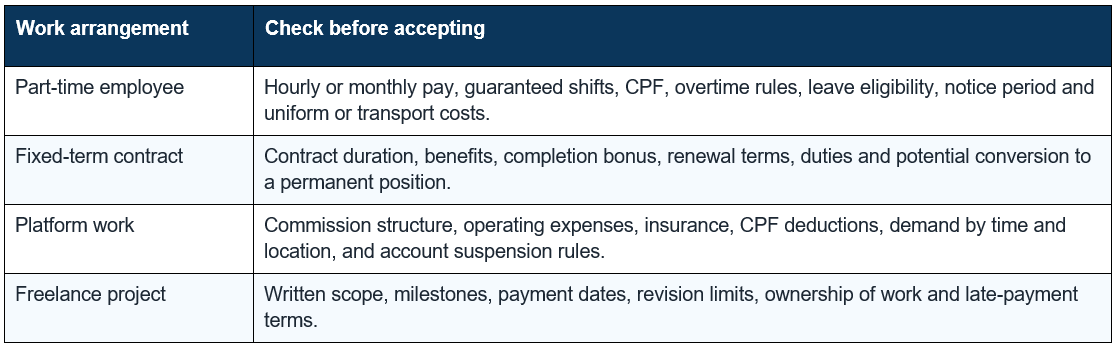
From 1 January 2025, Singapore’s Platform Workers Act introduced protections covering work injury compensation, CPF contributions and representation rights for covered platform workers. Platform workers should still budget for variable demand and understand which expenses reduce their actual take-home income.
How Interns Can Convert an Internship into a Full-Time Offer
Treat an internship as a long interview. Employers notice reliability, communication, learning speed and whether an intern makes the team’s work easier.
• Agree on clear goals with your supervisor during the first week.
• Ask for feedback regularly and act on it visibly.
• Keep a record of tasks, results, compliments and skills learned.
• Volunteer for useful work, but complete your assigned responsibilities first.
• Build professional relationships beyond your immediate supervisor.
• Three to four weeks before the internship ends, ask what would be required to be considered for a full-time role.
How to Write a Singapore Resume That Gets Shortlisted
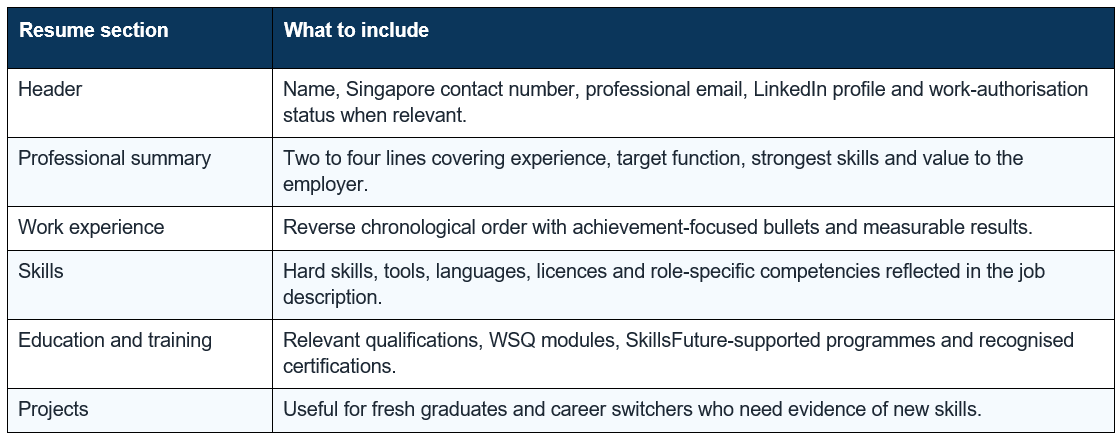
A strong Singapore resume is easy to scan, relevant to the vacancy and supported by evidence. Most candidates should aim for one to two pages, while senior professionals may need more space when every section remains relevant.
Use achievement bullets, not duty lists
Weak: “Responsible for deliveries and customer service.”
Stronger: “Completed an average of 18 daily deliveries across eastern Singapore while maintaining accurate documentation and a clean safety record.”
The stronger version shows scale, location context and reliability. Use numbers only when they are accurate and can be explained in an interview.
Make your resume ATS-friendly
• Use standard headings such as Work Experience, Education and Skills.
• Avoid text-heavy graphics, skill bars and important information placed only in headers or images.
• Use keywords naturally when they accurately describe your experience.
• Save the file with a professional name, such as Firstname_Lastname_Resume.pdf.
• Proofread job titles, dates, contact details and company names.
Singapore Interview Tips
Prepare specific examples instead of memorising generic answers. The STAR method — Situation, Task, Action and Result — helps you explain what happened, what you were responsible for, what you did and the outcome.
Questions to prepare for
• Tell me about yourself.
• Why are you interested in this company and role?
• Tell me about a difficult customer, deadline or team situation.
• What achievement are you most proud of?
• How do you use digital or AI tools responsibly in your work?
• What are your salary expectations and notice period?
• Why are you leaving your current job or changing careers?
Research before the interview
Understand the company’s products, customers, recent developments and the main responsibilities of the role. Prepare two or three thoughtful questions about expectations, team structure, success measures and the next stage of the process. Do not ask only about leave, benefits and working hours in the first few minutes of the interview.
A 30-Day Singapore Job Search Plan
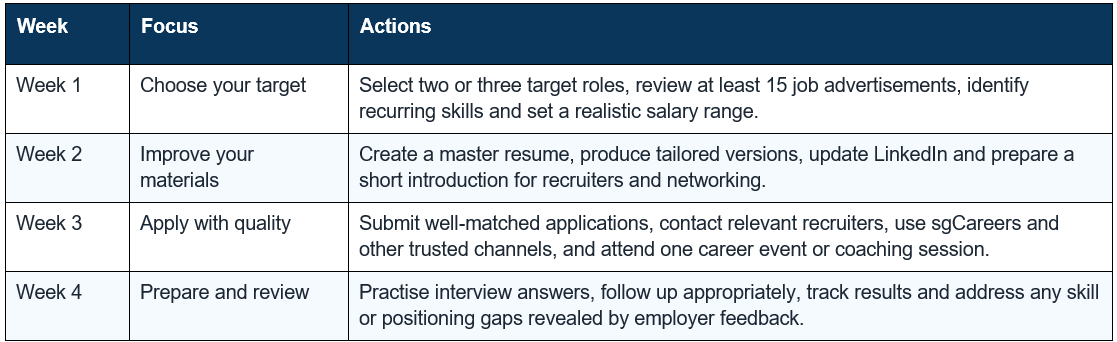
A useful job-search tracker should record the company, role, date applied, resume version, contact person, next step and outcome. After 20 to 30 targeted applications, review the data. A low shortlist rate usually indicates a targeting or resume problem; interviews without offers often indicate an interview, expectations or role-fit issue.
Frequently Asked Questions About Finding a Job in Singapore
Is it difficult to find a job in Singapore in 2026?
The market is more selective, especially for popular entry-level and office roles, but it is not frozen. MOM reported 73,300 vacancies in March 2026 and more vacancies than unemployed people overall. Candidates still need to target suitable roles and demonstrate relevant skills.
Which sectors are hiring in Singapore?
Growth-sector entry-level vacancies are present in Financial & Insurance Services, Information & Communications, Professional Services, and Health & Social Services. MOM also reported sustained demand for software, data, systems and engineering professionals.
How long should a Singapore resume be?
One to two pages is suitable for most fresh graduates and early- to mid-career professionals. Senior candidates may use more space when the additional information is relevant and concise.
Should a fresh graduate accept a contract job?
A contract role can be worthwhile when the duties are relevant, the employer is credible, the learning is clear and the experience improves future employability. Review the benefits, duration and possibility of extension or conversion before accepting.
What support is available for a career switch after age 40?
Eligible Singapore Citizens aged 40 and above can use the S$4,000 SkillsFuture Credit (Mid-Career) top-up and may qualify for training allowances for selected full-time or part-time long-form programmes. Career Conversion Programmes may also support transitions into substantially different or growth roles.
How can I improve my resume for an ATS?
Use standard headings, include relevant keywords naturally, keep formatting simple, describe achievements with evidence and avoid placing important information only inside graphics or images.
Can part-time work lead to a full-time job?
Yes. Retail, food services, logistics, events, administration and customer-service employers may convert reliable part-timers when permanent vacancies arise. Treat every shift as evidence of punctuality, teamwork and performance.
Where can I find jobs in Singapore?
Use reputable Singapore job portals, employer career pages, recruiters, career fairs, professional networks and public career services. Browse sgCareers regularly and set a routine for reviewing newly posted roles.
Start your next job search with sgCareers
Browse the latest Singapore job openings, compare opportunities and apply for roles that match your skills, experience and preferred work arrangement.
Visit sgCareers.com.sg and check new listings regularly.